
When was the last time you used the search box on your own website? If the answer is “not recently,” you are probably not alone. Site search is easy to ignore until a visitor types something perfectly reasonable and gets nothing useful back.
The problem is not always missing content. Often, the page exists, but the visitor uses different words from the ones on the page. That is where traditional website search can struggle. Breezy AI Search takes a different approach by matching meaning and intent, not only exact wording.
Why website search can fall short on WordPress

WordPress has built-in search, and for simple keyword queries it can do the job. It searches common content fields and uses relevance rules for search results. The limitations become more obvious when visitors do not use the same wording as your content.
- Typos can affect search results. A misspelling such as “wordpres hosting” may fail to surface a page about WordPress hosting unless another search layer handles fuzzy matching.
- Synonyms are easy to miss. A visitor may search “shipping cost” while your page is called “Delivery Fees.” Keyword search does not automatically understand that the two ideas are related.
- Natural-language questions are harder to interpret. A question such as “Can I get a refund after 30 days?” expresses an intent that may not directly match the wording used on a refund policy page.
- Custom fields may not be included by default. Content stored in ACF or other custom fields often needs extra configuration or a search plugin before WordPress can search it.
- Ranking control is limited. You can improve WordPress search with plugins and custom code, but teams that need stronger relevance controls usually need a more purpose-built search layer.
These limitations are some of the main reasons website search experiences fail users.
Many WordPress search plugins improve indexing, weighting and fuzzy matching. AI website search goes a step further by trying to match the visitor’s intent to the content that is most likely to answer it.
How Breezy AI Search works

There are really two parts to the process: building the index, and answering a visitor’s search.
Crawl. Breezy AI Search visits the site’s public pages and adds them to its search index. New and updated pages are picked up again based on the plan’s recrawl schedule.
Understand. The indexed content is represented by meaning and context, not only exact keywords. This is what allows semantically related wording to match.
Match. When someone searches, it compares the query with the indexed content and surfaces the most relevant results.
Answer. Using RAG search, AI Answer can generate a direct response from the website’s indexed content instead of showing only a list of links.
Breezy AI Search typically surfaces matching sources in milliseconds. A more comprehensive AI-generated answer can take a few seconds, depending on the query, connection and device. The brief wait is balanced by the value of receiving a direct, contextual answer.
What about AI hallucinations?
There are really two parts to the process: building the index, and answering a visitor’s search.
Crawl. Breezy AI Search visits the site’s public pages and adds them to its search index. New and updated pages are picked up again based on the plan’s recrawl schedule.
Understand. The indexed content is represented by meaning and context, not only exact keywords. This is what allows semantically related wording to match.
Match. When someone searches, it compares the query with the indexed content and surfaces the most relevant results.
Answer. Using RAG search, AI Answer can generate a direct response from the website’s indexed content instead of showing only a list of links.
Breezy AI Search typically surfaces matching sources in milliseconds. A more comprehensive AI-generated answer can take a few seconds, depending on the query, connection and device. The brief wait is balanced by the value of receiving a direct, contextual answer.
Setting up Breezy AI Search on WordPress
The setup is relatively short. You add your website to Breezy AI Search, let it crawl and index the public pages, then install the search widget using the snippet provided in the dashboard. For most sites, the setup can be completed within minutes.
On WordPress, follow Breezy AI Search’s installation instructions and add the snippet through a supported header/footer or code-injection method. Marketers can also deploy the snippet through Google Tag Manager (GTM). If you already use a code snippets and header/footer scripts tool, that may be the easiest option. Developers can add the snippet directly through custom code, provided the implementation is maintained properly.
Before indexing, review which pages should actually appear in search. Archive pages, old campaign pages or other low-value URLs may not be useful to visitors. Breezy AI Search allows pages to be excluded from the index, so it is worth cleaning this up rather than letting every crawlable URL compete for attention.
The controls that keep search useful over time
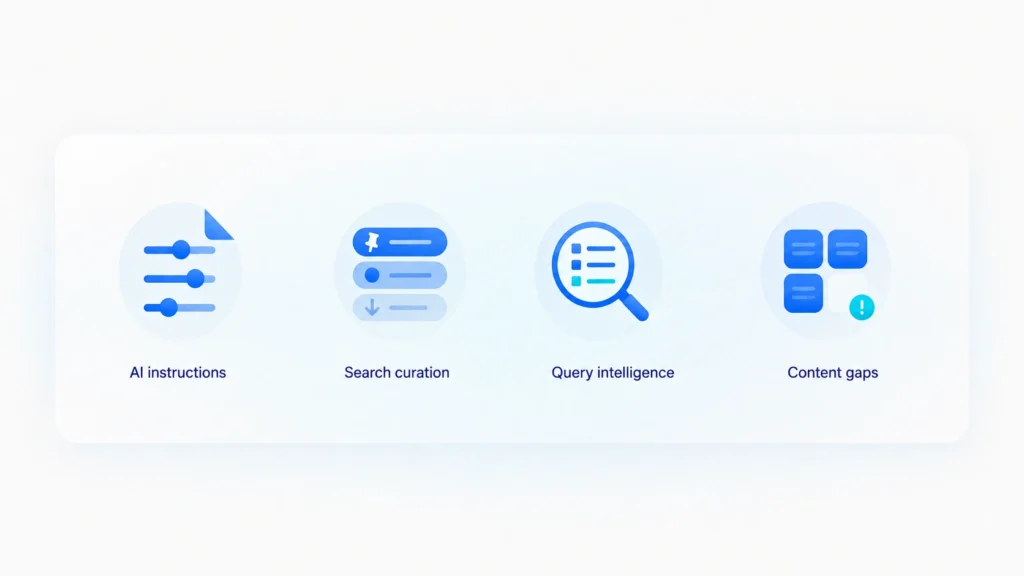
Good site search is not a one-time installation. It needs enough control to stay relevant as the website changes.
Custom AI instructions. On supported plans, you can guide the tone, scope and rules used for AI-generated answers so the output better matches your brand and content priorities.
Search curation. Breezy AI Search lets teams pin, demote or hide results for specific queries without changing the underlying page content.
Query intelligence. Searches are grouped into categories so teams can see what visitors are trying to find, not just a raw list of keywords.
Content gaps. Searches with no or few useful results can be reviewed as potential gaps in the website content.
What it costs
Breezy AI Search currently lists Growth at US$29/month, Professional at US$49/month, Scale at US$119/month and Enterprise as custom pricing. The pricing page lists 100 indexed pages on Growth, 500 on Professional and 2,000 on Scale.
Every plan includes semantic search and AI Answer. Higher tiers expand page and usage allowances and add capabilities such as query intelligence, search curation, Custom AI Instructions, white-label branding and more frequent manual crawls.
Breezy AI Search offers a 14-day free trial on the Growth plan with no credit card required.
Where it's a good fit, and where it isn't

Breezy AI Search makes the most sense on sites with enough content that visitors genuinely have to search: knowledge bases, documentation, support hubs, content-heavy corporate sites, and e-commerce sites with policies or product information that people regularly look up.
Even a small brochure site can benefit when visitors need a faster way to reach key services, policies or contact information. The Growth tier offers a relatively affordable way to add a more modern search experience. Breezy AI Search is less suitable when most useful content sits behind a login and cannot be crawled.
Breezy AI Search can index multilingual content. However, control over the language used in AI Answers is still being refined, so multilingual sites should test response language and important queries before launch. On-site AI search also does not change how external AI engines such as ChatGPT or Google’s AI features discover a website; on-site search and AEO/GEO are separate concerns. Learn how AI search, AEO and GEO work together to improve how visitors and search engines discover your content.
FAQ
What is AI website search?
AI website search uses semantic matching to understand the meaning behind a query instead of relying only on exact keywords. Depending on the tool and plan, it may also generate a direct answer from the site’s indexed content.
Is Breezy AI Search a WordPress plugin?
Not in the traditional WordPress sense. Breezy AI Search Plugins is a hosted service added with an HTML snippet, so it works without installing a conventional server-side WordPress search plugin.
Will it slow down my site?
Breezy AI Search handles crawling, indexing and search processing on its own infrastructure rather than through your website database search logic. The front-end widget is still a third-party script, so it is worth testing real-world site performance after installation.
Do I need to restructure my content first?
Usually not. Breezy AI Search can crawl content that is already published, but the pages still need to be public, crawlable and clearly written if you want useful search results.
Can I stop certain pages from appearing in website search results?
Yes. Breezy AI Search lets you exclude pages from the index and add them back later if needed.
How fast are results?
Matching sources typically appear in milliseconds, while a comprehensive AI-generated answer can take a few seconds. Actual speed will still depend on the query, the visitor’s connection and device, and the way the widget is implemented.
Does Breezy AI Search support multilingual websites?
Yes. Breezy AI Search can index multilingual content. Because control over AI Answer response language is still being refined, test the languages and queries that matter most before launch.
The bottom line
Website search is easy to neglect because it sits quietly in the corner of a site. But when someone uses it, they usually have a specific goal. A search experience that cannot handle normal wording, typos or intent creates friction at exactly the moment a visitor is trying to find something.
Breezy AI Search provides a straightforward way to add semantic search to WordPress without rebuilding the site around a new search system. The strongest reason to consider it is not simply that it uses AI, but that it gives visitors more ways to express what they need while giving site owners better control and visibility into those searches.
If you are considering it, use the 14-day trial to test the questions your visitors ask most often. Search for them the way a real person would, including vague wording and typos, and compare the results with your current website search. That will tell you more than a feature list will.