RAG search improves content marketing and SEO by rewarding content that answers specific questions clearly, in self-contained passages AI can quote. Traditional search ranks whole pages; RAG retrieves and cites individual passages, so smaller, sharper content can now compete with far bigger domains — in search results and in your own site search.
What is RAG search?
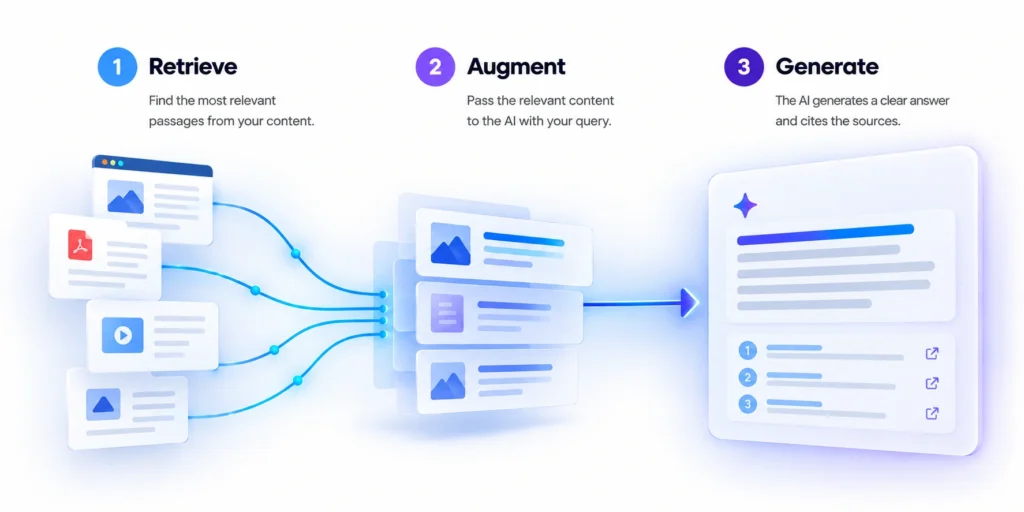
RAG (retrieval-augmented generation) is how AI search tools like Google AI Overviews, ChatGPT and Perplexity answer questions: they retrieve relevant passages from the web, then generate an answer that cites them. They often run several related searches at once, known as query fan-out (Google Search Central). New to RAG? Read our explainer: What Is RAG Search?
| Aspect | Traditional search | RAG search |
|---|---|---|
| What it returns | A ranked list of links | A written answer with cited sources |
| Unit that competes | Whole pages | Individual passages |
| Matching | Keywords plus ranking signals | Meaning and intent (semantic match) |
| What wins | Authority and relevance for one query | Clear, accurate answers to many related questions |
How RAG search improves content marketing
RAG rewards useful answers, not just more content. Here’s how it changes the way marketers plan, write and optimise content.

1. Make every section worth citing
AI search retrieves individual passages, not just entire articles. Use clear headings and answer questions directly so each section can stand on its own.
3. Build topic clusters, not isolated posts
AI search can retrieve information from multiple related pages. Connecting articles around a core topic increases the opportunities for your content to be discovered and cited. Explore our SEO strategy guide to find out how you can maximise your SEO performance.
4. Turn existing content into instant answers
RAG-powered website search helps visitors find direct answers from your blogs, FAQs and service pages, without digging through multiple links.
For a practical example, discover how Breezy AI Search uses semantic search and RAG to help visitors find relevant information from your existing website content.
How RAG search improves SEO and GEO
RAG doesn’t replace SEO. It raises the bar and adds a second route to visibility: GEO, making content easy for AI to retrieve and cite.

SEO fundamentals still decide retrieval
AI can’t cite a page it can’t find. Google says no special optimisation is needed for its AI features; standard SEO, including internal linking and crawlable content, still applies (Google Search Central). Refresher: search indexing and ranking.
Page one is no longer the only way in
Ahrefs research from March 2026 found only around 38% of AI Overview citations came from top-10 pages, versus 76% in its July 2025 study (summary via ContextBolt). Its methodology changed between studies, but the lesson holds: a clear answer to a sub-question can be cited without a top ranking.
Better site search supports better UX
RAG-powered site search cuts search exits and keeps visitors engaged, especially on mobile. Learn to measure it in 5 Signs Your Website Search Is Hurting Conversions and Why Your Mobile Conversion Rate Is Half Your Desktop. For the local view, read AI Is Changing Search in Singapore.
6-step checklist to optimise content for RAG search
Write so any section could be lifted out and still make sense. For the full version, see our GEO checklist.
- Lead with the answer in the first one or two sentences under each heading.
- Use question-style headings that match how people ask.
- Keep sections self-contained. Avoid “as mentioned above”.
- Add specifics and sources: numbers, dates, examples and links to original research.
- Link related posts into clusters, with structured data that matches the visible page.
- Refresh key pages and their “last updated” date regularly.
New to this? Start with our SEO basics hub or 5 Ways to Increase Your Web Traffic.
How RAG search improves content marketing
Is RAG the same as GEO?
No. RAG is the technology AI search uses to retrieve and cite sources. GEO is the practice of structuring content so RAG systems can find and cite it.
Which AI tools use RAG?
Google AI Overviews and AI Mode, ChatGPT search, Perplexity, Microsoft Copilot and most AI site search tools. Each retrieves differently, so results vary by platform.
How long do GEO changes take to show results?
There’s no fixed timeline. Pages must be recrawled and re-evaluated first, which can take days to months.
How can I tell if AI tools cite my content?
Check analytics for referrals from chatgpt.com and perplexity.ai. Google Search Console includes AI Overview and AI Mode clicks in Web search traffic.
The bottom line
RAG search rewards content that is clear, specific and well connected. Plan around real questions, write self-contained sections, and keep your SEO fundamentals strong. The winners won’t publish the most; they’ll publish what’s easiest to trust and quote.
Ready to make your content work harder? See how Breezy AI Search turns your existing website content into instant answers for visitors, or talk to our team about an SEO and GEO content review.