
What Does GEO Mean?
Search is no longer just about ranking on a results page.
With AI-powered search tools like ChatGPT, Perplexity, and Google’s AI Overviews, users now ask full questions and receive direct, summarised answers. Instead of clicking through several websites, they get one answer generated from multiple sources — and often never visit a site at all.
That shift is why GEO matters.
GEO stands for Generative Engine Optimisation. It is the practice of making your content easier for AI-powered search engines and answer engines to understand, summarise, and reference. In simple terms, GEO helps your content show up — and be quoted accurately — in AI-generated answers.
How GEO Works
GEO is about helping AI systems understand what your content is about and when to use it.
When an AI search feature uses web retrieval, it searches for relevant information from websites and other available sources. It then uses that information to generate a grounded response. This retrieve-and-generate process is commonly known as retrieval-augmented generation, or RAG.
Here’s the difference in practice. Instead of writing:
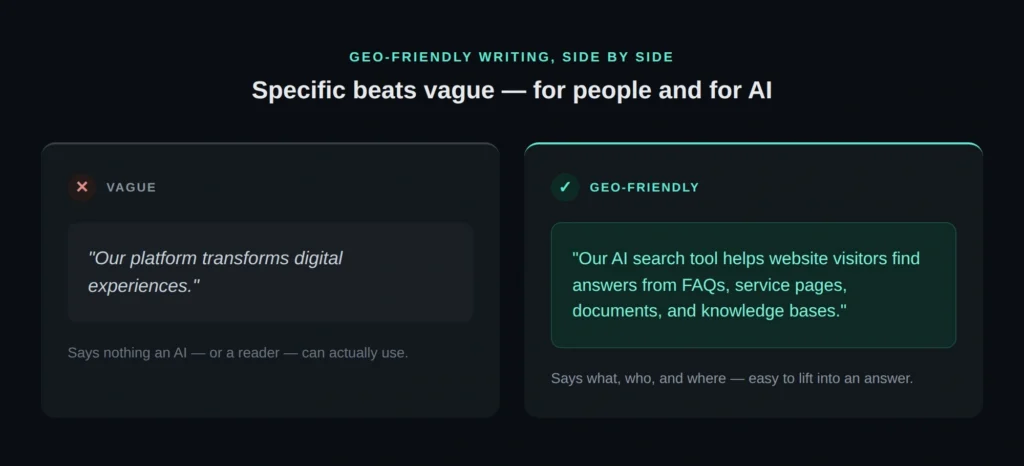
The GEO-friendly version wins because it’s specific — it says what the product does, who it helps, and where the answers come from. That’s exactly the kind of statement an AI can lift into an answer.
What Makes Content GEO-Friendly
GEO-friendly content is easy to understand, retrieve, and summarise. In practice that means clear headings, direct explanations, useful examples, and specific answers to the questions people actually ask.
A good GEO-friendly article makes five things obvious to both humans and AI:
- What the topic is about
- Why it matters
- Who it is for
- How it works
- What the reader should do next
This isn’t about stuffing articles with keywords or writing for machines. Early research supports the value of clear, well-supported content. The KDD 2024 paper GEO: Generative Engine Optimization tested strategies such as adding credible citations, relevant quotations and specific statistics. In its experimental benchmark, some approaches improved content visibility in generative answers by up to 40%, although the results varied across topics and domains.
This does not mean that adding statistics or quotations automatically guarantees an AI citation. It shows that useful, verifiable and well-supported information may be easier for generative systems to incorporate into their answers.
GEO Is Not a Replacement for SEO
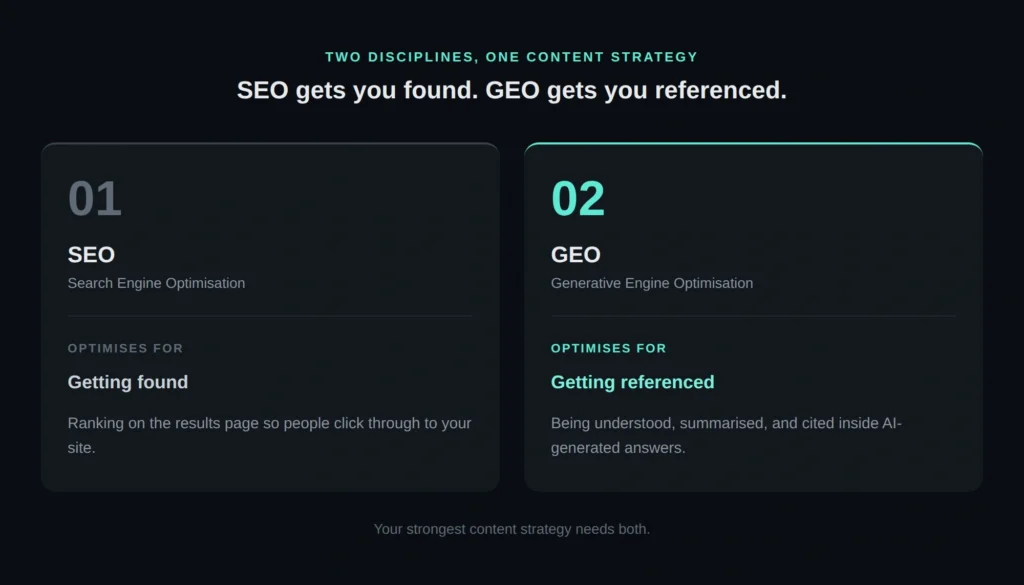
GEO does not replace SEO. It builds on it.
SEO helps search engines crawl, index, understand and surface your content. GEO focuses on making that content easier for AI-powered search tools to interpret, summarise and reference.
In simple terms:
SEO helps your content get found.
GEO helps your content get understood and referenced.
The strongest content strategy supports both. For practical steps, read our guide on how to improve your content for GEO.
Final Thoughts
GEO is becoming more important as search shifts from links to answers. Users want direct, useful responses, and AI tools are changing how those answers are found, summarised, and presented. For businesses, that makes content clarity matter more than ever.
The goal isn’t to chase every new AI search trend. It’s to create content that is helpful, specific, structured, and trustworthy. When your content is easy for people to understand, it’s easy for AI-powered search systems to understand too.
That is the real value of GEO.