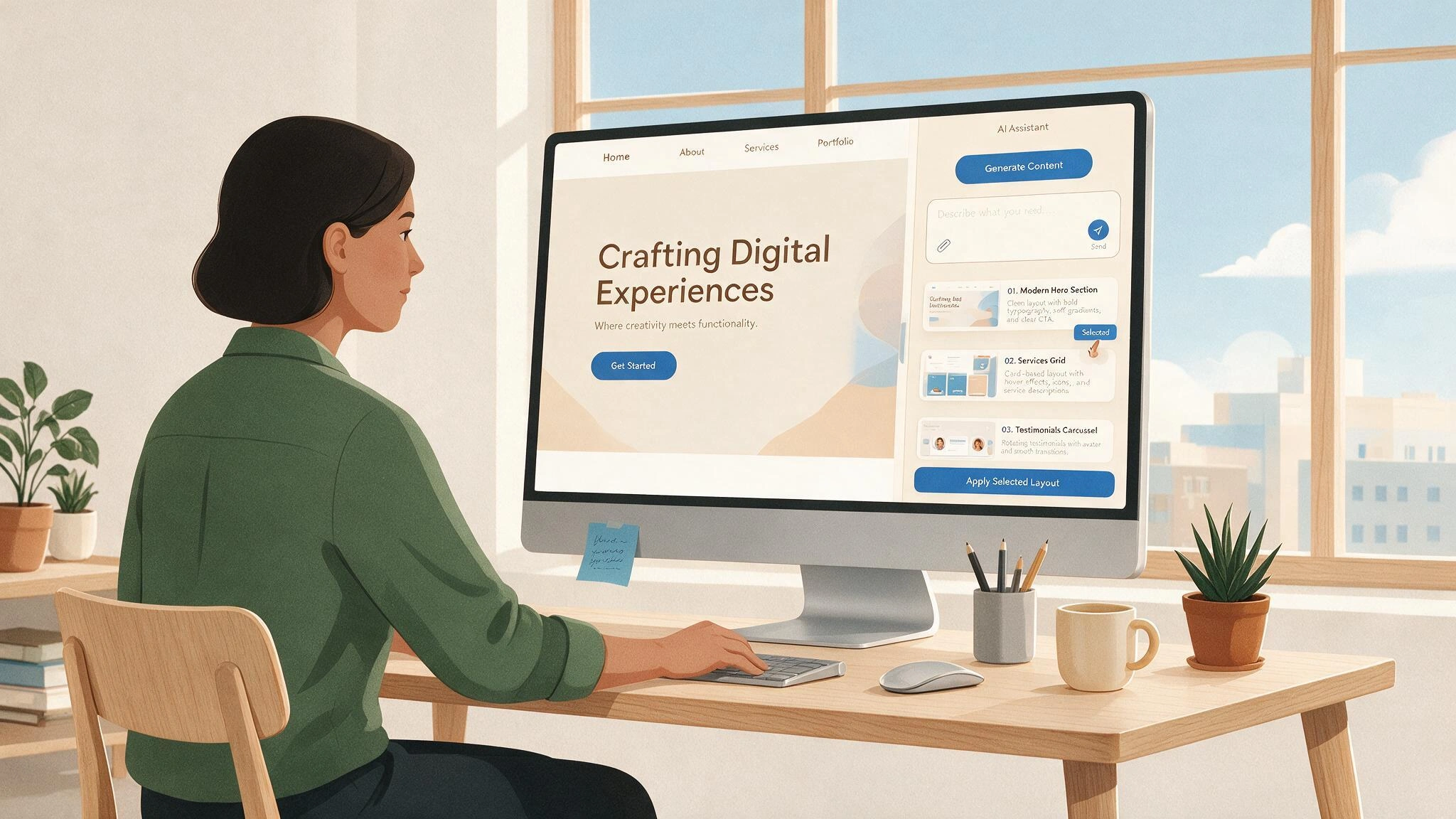
Web design used to be fairly straightforward. If a website looked clean and professional, that was usually enough to make a good impression.
That is no longer the case.
Today, when someone lands on your website, they are not paying attention to your colour palette or layout choices. They are trying to answer one question as quickly as possible.
“Is this what I need?”
If the answer is not clear within a few seconds, they move on. This is especially true in Singapore, where people are used to fast apps, efficient services, and getting things done quickly. That expectation carries over to websites.
So the role of design has shifted. It is no longer just about making a site look good. It is about making it work well.
What "Modern Web Design" Actually Means Today

Modern web design is about speed, clarity, and seamless interaction.
When people talk about modern web design, they often think about trends — animations, colour schemes, layouts.
In reality, it comes down to something much simpler.
Modern web design is about removing friction.
That means making it obvious what the website is about, making it easy to navigate, making it fast to load, and making it clear what users should do next. If a visitor has to stop and think too much, the design is not doing its job. As we covered in our post on web design standards and best practices, just having a website is no longer enough — how it works matters just as much as how it looks.
Users Are Not Exploring Your Website the Way You Think

Most visitors won’t read your page. They’ll scan it.
Most website owners imagine visitors browsing through pages, reading content, and gradually learning about the business. That rarely happens.
People skim. They scroll quickly. They jump between sections. Sometimes they do not even reach the middle of the page before deciding whether to stay or leave.
Instead of asking “Does this look nice?”, the more useful question is: “Can someone understand this in five seconds?”
Clear headlines, a simple structure, and obvious next steps matter more than visual complexity.
Performance Is Part of the Design
In Singapore, a slow website stands out immediately — and not in a good way.
Even a delay of a few seconds can make a website feel unreliable or outdated. Most users will not wait. They will simply leave and try another option.
This is why website performance is no longer just a technical concern. It is a design consideration from the very beginning.
Google’s Core Web Vitals — three metrics that measure loading speed (LCP), responsiveness (INP), and visual stability (CLS) — are now confirmed ranking factors in search results. When two pages compete for the same keyword, the one that delivers a better user experience has the edge.
Decisions like using heavy animations, loading large images, or adding too many visual effects all affect how fast a site feels. One practical step any website owner can take is to run their site through Google PageSpeed Insights — it is free, takes seconds, and shows exactly where performance is being lost.
If you are unsure where to start with image optimisation specifically, our guide on how to optimise images and videos for your website is a good place to begin.
Mobile Is the Main Experience, Not a Secondary One

Mobile-first isn’t a trend—it’s reality. Design for the small screen, where your users actually are.
Many websites are still designed with desktop in mind first, then adjusted for mobile.
But the reality is that most visitors in Singapore will be on their phones. Statista reports that mobile internet penetration in Singapore is over 95 percent, and that figure continues to grow. Users could be on the MRT, walking between appointments, or multitasking at home.
Your website needs to work well with minimal effort in these situations. Buttons need to be easy to tap. Content needs to be easy to scan. Navigation needs to feel natural without zooming in or hunting around.
If a user has to do extra work just to read your page, they are unlikely to stay long enough to take any action.
Trust Is Established Very Quickly

First impressions happen in seconds—your design either builds trust instantly or loses it just as fast.
When someone lands on a website for the first time, they pick up signals almost immediately.
Does this look professional? Is this a legitimate business? Can I trust what they are offering?
Design plays a significant role in answering those questions — often before a single word is read. Small things like a clean layout, consistent fonts, clear contact information, and genuine testimonials can make a meaningful difference. An outdated or cluttered design can create doubt, even if the service itself is excellent.
This is also why a UX-friendly website does more than look good — when visitors feel confident in what they see, they are far more likely to reach out.
Looking Good Is Not the Same as Guiding Users
There are many websites today that look polished but still do not perform well.
They have smooth animations, modern layouts, and carefully chosen visuals. But visitors still leave without taking any action.
The reason is usually that the website does not guide them anywhere. It presents information, but it does not lead users toward a clear next step.
Modern web design pays closer attention to clear calls to action, a logical flow of information, and reducing unnecessary steps between arriving and converting. A well-designed website should feel almost intuitive to use — users should not have to search for what to do next.
If you are looking to grow the number of people taking action on your site, our post on 5 ways to increase your web traffic covers a range of approaches that work alongside strong design.
AI Is Quietly Changing What Users Expect

AI is raising the bar—users now expect faster, smarter, and more personalised digital experiences.
AI is beginning to shape how people interact with websites, even if they do not always notice it.
As more services offer instant answers, smart recommendations, and personalised experiences, user expectations gradually shift. Websites that feel static or generic can start to feel less relevant by comparison.
This is why more businesses in Singapore are exploring features like chat assistants, dynamic content, and personalised messaging. Singapore is also playing an increasingly significant role in how AI is governed and adopted across Southeast Asia — something we explored in depth in our recent article on how Singapore is shaping AI development in the region.
The goal, though, is not to make a website feel high-tech. It is to make it feel helpful. A well-placed chat feature that answers a common question at the right moment is more valuable than a complex feature that simply demonstrates capability.
Why So Many Websites Still Feel the Same
Templates have made it easier than ever to build a website. But they have also made many websites look alike.
Visitors have seen the same layouts, the same section structures, and the same visual styles across dozens of sites. When everything looks familiar, nothing is particularly memorable.
Good web design today is not about being flashy or unconventional. It is about being clear, purposeful, and distinct enough that visitors leave with a genuine sense of who you are — and that is harder to achieve with an off-the-shelf template. Our works are a good example of what that looks like across different industries.
One area where businesses can genuinely stand out is through richer visual experiences. Our post on enhancing web design with 3D models explores how formats like glb and gltf files can add real depth to a site — without compromising performance when implemented thoughtfully.
A Few Questions Worth Asking About Your Own Website
If you are thinking about your website — whether building new or revisiting an existing one — these are worth considering honestly.
Does your homepage communicate clearly within a few seconds?
If a new visitor cannot immediately understand what you do and who you serve, that is worth addressing.
Does your site load quickly, especially on mobile?
Performance directly affects how users feel about your business, and it has a measurable impact on search rankings too. If you are new to SEO terminology around this, our SEO glossary is a useful reference.
Is there a clear path for users to take action?
Whether that means making an enquiry, requesting a quote, or simply learning more — the next step should always be obvious.
Does the design reflect the quality of your business?
Your website is often the first point of contact. It should feel consistent with the experience you actually deliver.
Final Thoughts
Web design in Singapore has changed, but perhaps not in the way most people expect. It is not about adding more effects, chasing the latest visual trends, or building something that looks impressive in a screenshot. It is about removing friction, improving clarity, and helping users take action without having to think too much.
The best websites today are not necessarily the most elaborate ones. They are the ones that work — clearly, quickly, and consistently.
A good-looking website might get attention. But a well-designed website gets results.
Looking to review or improve your website? Browse our works to see what we have built, or get in touch and we are happy to share our thoughts.