
At WhooshPro, we work with organisations across Singapore — from large enterprises to established institutions — on digital experiences that need to perform at scale. And over the past 18 months, one trend we’ve observed is that Singapore is playing a growing role in how AI is governed and deployed responsibly.
This article explores what’s happening, why it matters, and what it means for your organisation’s digital presence.
The data suggests a strong trend
Before we dive in, let’s look at where Singapore actually stands right now.
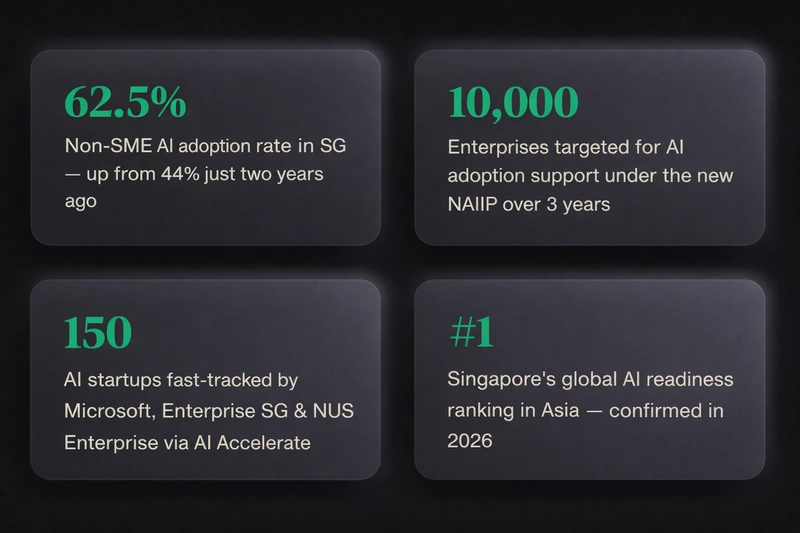
The image above shows the statistics of how Singapore is much more prepared in AI than we think.
For organisations in Singapore — whether enterprise, public institution, or growth-stage business — these numbers signal that AI-integrated digital experiences are rapidly becoming the baseline expectation, not the exception. The shift is already happening. The question is whether your digital presence is ready for it.
The world’s first agentic AI governance framework
In January 2026, Singapore’s Minister for Digital Development Mrs Josephine Teo announced the Model AI Governance Framework for Agentic AI (MGF) at the World Economic Forum in Davos —providing a structured reference for organisations developing governance approaches for agentic AI systems.
What is Agentic AI?
Unlike standard AI that responds to prompts, agentic AI systems can independently plan tasks, select tools, and execute multi-step actions without constant human input. Think of it as an AI that doesn’t just write your product description — it researches competitors, updates your web copy, and schedules a follow-up review, all on its own.
At WhooshPro, we see this framework as a practical checklist for deploying AI responsibly across digital products. Whether you’re building with agentic AI or integrating existing tools, this is likely to influence the standards organisations will need to meet. Agentic AI is expected to play an increasing role in digital systems. With Singapore offering a reference point for organisations building responsibly, they will be grounded in four core dimensions:
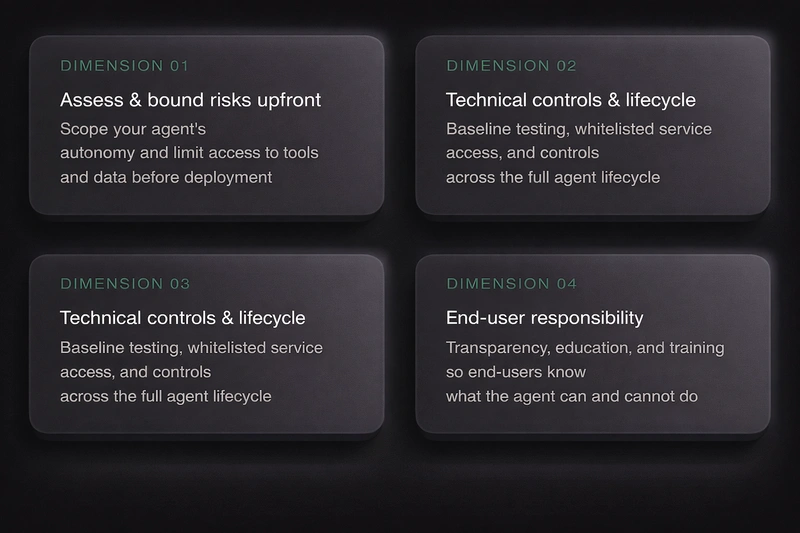
The technical controls dimension overlaps closely with good web security hygiene — things like access control, monitoring, and regular testing. If you haven’t revisited these recently, our guide on keeping your WordPress site safe and secure is a practical starting point.
Strong funding support is emerging — across public and private sectors
Singapore’s Budget 2026 included the formation of a National AI Council chaired by PM Lawrence Wong, the launch of a Champions of AI programme, and enhancements to the Productivity Solutions Grant. These directly translate into funding pathways for local businesses.
Google’s expanded Majulah AI initiative brings AI training to 500 graduates and professionals via the Skills Ignition SG AI Challenge (in partnership with IMDA), plus AI Cloud Takeoff for developers and startups. Microsoft, Enterprise Singapore, and NUS Enterprise are co-funding 150 AI startups through AI Accelerate, with an Investor Day in May 2026.
The National AI Impact Programme (NAIIP) targets 10,000 enterprises over three years. What typically follows an organisation’s AI adoption push is a need to update their digital front door — their website, user journeys, and content systems — to match.
The startup scene is no longer just fintech
Singapore’s AI ecosystem now spans healthcare, retail intelligence, enterprise automation, e-commerce, and foundational infrastructure. Some of the most interesting players making waves in 2026:
- Agnes AI — nearing US$20M ARR with fully in-house AI agent products serving nearly 10 million users, with developer-facing APIs for agentic infrastructure planned for Q2 2026.
- Wiz.ai — conversational AI for enterprise customer service, backed by significant Series B funding, powering voice and chat experiences across multiple industries.
- Grab — continually investing in GrabMaps, its AI-powered geospatial intelligence platform used by millions monthly across Southeast Asia.
What’s notable isn’t just the funding — it’s the breadth of sectors being transformed. Every one of these companies needs digital products that can handle AI-generated content, complex user flows, and performance at scale. That demand calls for digital partners who understand both design craft and technical complexity — not just off-the-shelf templates.
While these developments highlight strong momentum, the ecosystem remains competitive, with challenges such as high operating costs and regional competition from other Southeast Asian markets.
What Singapore's AI push means for how you build digitally
Here’s the honest take: Singapore is taking an active approach to developing its AI ecosystem, with a strong focus on building infrastructure for responsible, enterprise-scale deployment.
1. AI is raising the bar for what users expect online
As AI tools become mainstream, users are starting to expect smarter, more personalised digital experiences — faster search, context-aware content, intelligent support. This raises the standard for what good UX actually looks like. Our guide on levelling up with a UX-friendly website covers the principles that matter most — and they become even more critical when AI is part of the experience.
2. Web design systems need to handle AI-generated content gracefully
AI-generated images, copy, and layouts are becoming standard in digital production. Designing systems that handle this content well — flexible grids, readable typography, optimised image formats — is increasingly a core competency rather than an afterthought. Our post on web design standards and best practices is worth revisiting through this lens.
3. Digital marketing is getting smarter — and more competitive
AI is reshaping how content gets created, how emails get personalised, and how campaigns get optimised. For organisations in Singapore, this is both an opportunity and a challenge — your competitors have access to the same tools. Solid digital marketing fundamentals are more important than ever as the baseline rises. If your team is still getting up to speed, our digital marketing explained guide is a useful primer.
How AI Is Redefining Modern Web Development
Singapore is taking an active approach to developing its AI ecosystem.With the world’s first agentic AI governance framework, serious national investment, and a startup ecosystem that’s growing fast across multiple industries — the foundation is already being laid for how AI shapes the region’s digital future.
For organisations operating here, the opportunity is growing, though outcomes will depend on how organisations adapt. The businesses and institutions that move thoughtfully — investing in better digital experiences, smarter integrations, and well-designed systems — are the ones that will pull ahead.
At WhooshPro, we partner with organisations across Singapore — from corporates to creative institutions — to translate these shifts into digital experiences that are purposeful, well-crafted, and built to last. If you’d like to explore what that looks like for your organisation, visit us at whooshpro.com or reach out at whooshpro.com/contact — we’d love to have that conversation.