There was a time when a website project started with a brief, a blank canvas, and the quiet dread of a client call that would inevitably end with “can we make the logo bigger?”
AI hasn’t fixed that one yet. Some things are sacred.
But almost everything else about how websites get made, and what clients think they are paying for, is changing fast. Webflow says more than 60,000 websites have already been published using its AI site builder, which can generate multi-page sites and design systems from a single prompt.
So the question is no longer, “Can AI design a website?”
It can.
The more interesting question for AI in web design is:
If AI makes websites easier to produce, what will clients expect from the people who make them next?
Before AI, the Website Was the Deliverable
Picture a fairly typical web project a few years back. Days of competitor research. A sitemap. Wireframes. Visual exploration. Placeholder copy. Responsive layouts. Dev handoff. Then the revisions — and the one urgent request nobody mentioned in the previous six weeks.
A huge share of the project’s value sat in producing the thing. Clients showed up with requests like “we need a new corporate site” or “make it look more like our competitor,” and the website itself was the deliverable.
Designers were the makers. They shaped hierarchy, built visual systems and translated brand guidelines into actual digital experiences.
AI is making production easier. The thinking is becoming the job.
When Production became the Easy Part
A prompt can now produce something in the time it used to take to open a dozen inspiration tabs. That doesn’t mean it’s ready to launch — but the blank-page problem is quietly disappearing.
Figma’s State of the Designer 2026 report surveyed 906 designers worldwide and found 89% say AI is helping them work faster, while 91% say it’s improving the quality of their output. That’s a real shift in what a “day one” looks like on a project.
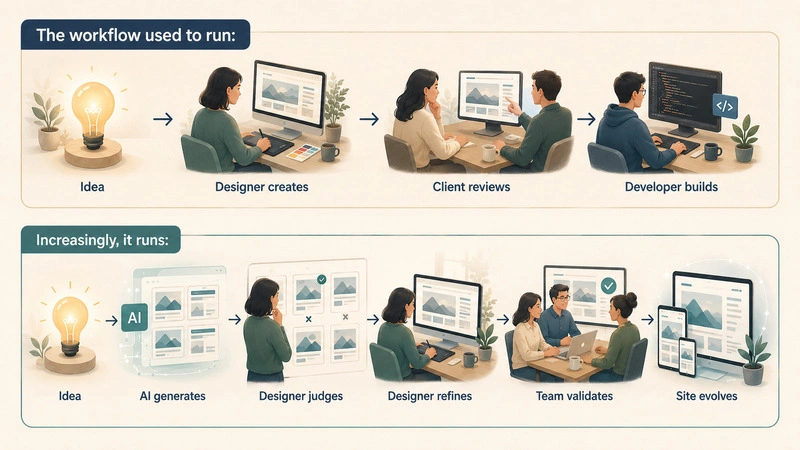
The important word is judges. Generating ten options is becoming easy. Knowing which one is right for the business and its audience is not.
We’ve started seeing this ourselves. Clients increasingly arrive with AI-generated homepage concepts, shifting the conversation from “Can you design this?” to “Which direction actually makes sense for our business?”
The role is moving from creating more ideas to evaluating the right ones.
When Designing Becomes More About Deciding
AI is very good at producing possibilities. Give it a brief and it will happily hand back option A through E, plus thirty-seven variations nobody asked for. Somebody still has to decide which one solves the actual problem — and a healthcare site shouldn’t behave like a fashion campaign, just because the model thought a floating gradient blob looked “innovative.”
A few human skills are becoming more valuable, not less, as a result.
Asking better questions.
When producing screens gets easy, understanding the problem gets harder to skip. Who’s actually using this site, what are they trying to find, and what’s stopping them from acting? AI can help explore answers. It has no idea what the business actually is.
Editing over generating.
The first AI draft is rarely the interesting part — what happens after is. Designers are increasingly editors of experience: cutting the unnecessary, sharpening hierarchy, deciding what earns the visitor’s attention. The job is shifting from “what should I create?” to “what should I keep?”
Protecting distinctiveness.
Here’s the catch nobody loves talking about: when good-looking design becomes cheap, everything starts looking good-looking in exactly the same way. Gradient, big headline, rounded cards, three benefit blocks, a sprinkle of glow. Suddenly a fintech startup, an HR platform, and an oat-milk subscription share a creative director.
Webflow has warned that over-reliance on generative AI could lead to more homogenised design across the web. A 2026 University of Washington-led study raised a similar concern, arguing that frictionless AI website generation can reinforce familiar design defaults unless creators deliberately push beyond the first output.
When everyone can generate something polished, taste becomes the actual differentiator.
Clients Want More Than a Website

This might be the bigger shift. Once a client knows AI can produce a homepage in an afternoon, “this took three days” stops sounding like a value statement and starts sounding like a question. A fair one.
Clients may care less about receiving a 15-page website and more about whether it generates leads, answers questions and supports the business.
The Questions Clients Are Starting to Ask
“Can you build this faster?”
Inevitable, and largely fair. AI genuinely speeds up early exploration, prototyping, and first drafts. The agencies that win won’t simply deliver faster—they’ll use the time they save to improve research, accessibility, QA, and optimisation. Fast execution isn’t the differentiator. Fast thinking is.
“Why did you design it this way?”
Pretty is getting cheap. Reasoning isn’t. Every decision—a CTA, the content order, even what’s left out—needs to connect back to a business goal, not a stylistic preference.
“What is my website doing for the business?”
“Launch it and forget it” is becoming harder to justify when conversion data, drop-off points, and content gaps are visible from day one. A website is increasingly judged by what it improves, not simply by how it looks.
“Can visitors just ask the website?”
Visitors increasingly expect to ask questions instead of hunting through navigation. In fact, the way visitors actually look for information on websites is often very different from how those sites were designed to be navigated. For content-heavy sites, AI-powered search and conversational interfaces are becoming a practical way to close that gap. Tools such as Breezy AI Search let visitors ask questions in natural language and get relevant answers from a website’s existing content, rather than opening page after page to find them.
But AI isn’t only changing how people interact with websites. It may increasingly be the thing doing the browsing for them.
When AI Becomes the Visitor

Designers have always built websites for people. Increasingly, they may also need to build them so AI agents can understand, navigate, and complete tasks on people’s behalf.
Early research points in the same direction. A July 2026 study found that an “agent-ready” e-commerce site achieved an 89.3% success rate for AI agents, compared with 49.3% for a human-focused version.
It’s still early, but an important question is emerging: can an AI acting on a customer’s behalf understand and use your website? If so, designing for both people and AI agents may become part of the brief.
SEO Moves Earlier Into the Conversation
SEO can’t sit quietly at the end of a project anymore. Site structure, content hierarchy and internal linking already shape how easily traditional and AI-powered search systems understand a website. Sites that add structured data and FAQ blocks have seen citation rates in AI search answers jump by roughly 44%, per BrightEdge research — the kind of groundwork our guide to AI search, AEO, GEO and AIO covers in more depth. As AI reshapes how people discover and evaluate businesses through search, these decisions increasingly need to happen during the website planning stage, not after the site has been built.
Google says there is no secret AI-search optimisation trick. Useful content, crawlability, internal linking and a strong page experience still matter, which means SEO increasingly needs to be considered while the website is being planned.
Before AI vs After AI, at a Glance
| Before AI | After AI |
|---|---|
| First drafts took a week | First drafts appear in hours |
| Designers spent most time producing | Designers spend most time selecting and refining |
| Clients paid mainly for execution | Clients increasingly expect strategic value |
| Launch was the finish line | Launch is the starting line for optimization |
| Visitors navigated menus to find answers | Visitors can increasingly just ask |
| Sites were built for humans only | Sites increasingly serve humans and AI agents |
| SEO arrived at the end of a project | Content structure gets decided upfront |
| Good-looking design was hard to produce | Distinctive, appropriate design is the differentiator |
| Deliverable: a website | Deliverable: a business outcome |
The future brief probably won’t sound like “we need a new website.” It’ll sound more like “we need customers to understand us faster, ask fewer repetitive questions, show up in both regular and AI-powered search, and keep improving after launch.” That’s not a request for a website. That’s a request for a solution — and deciding what that solution should actually do is where the value is heading.
FAQs
How is AI changing web design?
AI is speeding up ideation, wireframing, content drafting, and prototyping, which frees designers to spend more time on strategy, user research, creative direction, and post-launch optimization.
Will AI replace web designers?
It’s automating parts of the workflow — first drafts, placeholder content, basic assembly — rather than the role itself. Strategic thinking, user understanding, and business judgment remain hard to replace.
Is AI-generated web design good for SEO?
Using AI doesn’t automatically help or hurt SEO. Google’s own guidance is consistent: focus on useful, original, people-first content and solid technical fundamentals, regardless of what tool produced the first draft.